
Cast iron has a way of humbling you fast. One minute the bead looks fine, the next you hear that faint ping — and a crack runs right through your repair. I ran into that more than once before I really understood How to Weld Cast Iron with Oxy-Acetylene and why this old-school method still works when done right.
Unlike mild steel, cast iron doesn’t forgive quick heat or rushed cooling. The wrong approach leads to brittle welds, hidden cracks, or parts that fail the moment they’re put back into service. Using oxy-acetylene gives you better heat control, which is critical for managing expansion and avoiding stress in the metal.
I’ve repaired engine blocks, housings, and brackets where patience mattered more than speed. Preheating, controlling the flame, and cooling the part slowly made all the difference between a solid repair and doing the job twice.
If you want a weld that actually holds — not just one that looks good for a minute — I’ll walk you through the exact steps and techniques that make this process work.
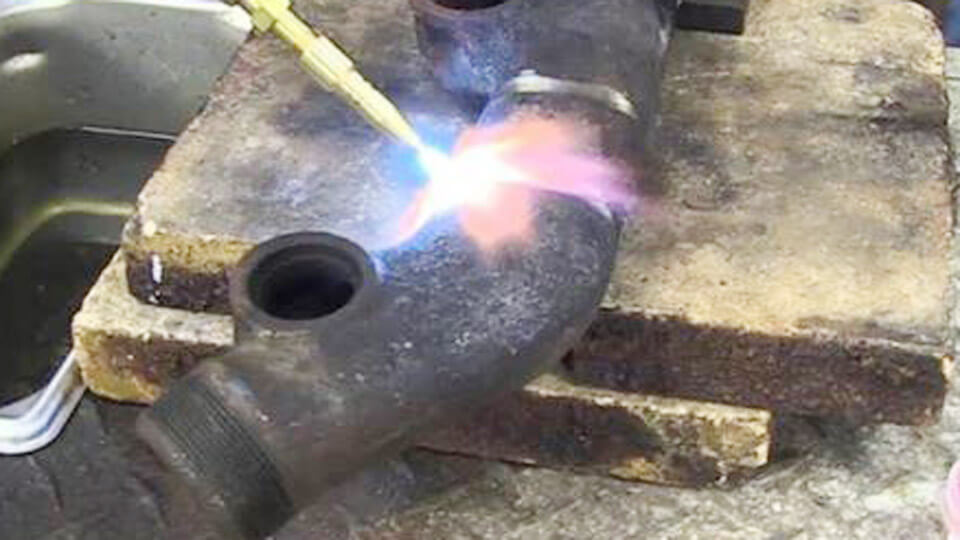
Image by yeswelder
Material Considerations for Gray Cast Iron
Gray cast iron contains 2.5–4.0% carbon, mostly as graphite flakes, yielding good compressive strength but low ductility. Welding disrupts graphite distribution near the fusion line, risking martensite or ledeburite if cooling exceeds critical rates.
AWS A5.15 RCI or RCI-A filler rods match base composition (3–4% C, 2–3% Si) to promote graphitization during slow cooling. Square rods (1/8 in or 3/16 in diameter) melt uniformly under oxy-acetylene heat. Avoid nickel or steel fillers for true fusion welds; they suit brazing or arc processes but produce mismatched deposits.
Joint Preparation
Grind or gouge a V-groove with 60–90° included angle, depth at least 75% of thickness for full penetration. Remove all scale, oil, and graphite using carbide burr or grinding wheel until bright metal appears.
Degrease with solvent or oxidizing flame (heat to 900°F for 15 minutes, then brush). For cracks, drill 1/4 in stop holes at ends to prevent propagation. Clean 1–2 in beyond repair area to prevent oxide entrapment.
Preheat Requirements
Preheat slows cooling rate below 50°F per hour, preventing carbide formation. For fusion welding, achieve dull red heat: 1200°F (650°C) minimum, verified by tempilstik or pyrometer. Small parts (<10 lb) allow local preheat to 900–1000°F (482–538°C) over 30 minutes.
Large castings require furnace or rosebud torch envelope heating to uniform temperature. Never exceed 1400°F (760°C) to avoid critical range where austenite transforms adversely. Protect from drafts with fire blankets or bricks.
Flame Setup and Tip Selection
Use neutral flame: inner cone sharp, no feather (adjust acetylene until feather appears, then reduce slightly). Slightly reducing flame (1–2 feather lengths) aids deoxidation on dirty castings. Typical pressures: acetylene 4–7 psi, oxygen 20–30 psi for stability.
Select medium-velocity tips (drill size 56–48 for 1/8–1/2 in thickness). Rosebud for preheat; standard welding tip for deposition. Maintain flame velocity to avoid turbulence.
Welding Technique
Maintain preheat temperature throughout. Direct flame to base metal until puddle forms (base melts before rod addition). Dip heated filler rod into borax-based cast iron flux (red powder), then feed into puddle edge. Use forehand technique: 10–15° torch angle forward, weave 1/8–1/4 in wide beads.
Travel speed 2–4 in/min depending on thickness. Keep puddle fluid but avoid overheating (puddle should not boil excessively). Deposit in short segments (2–4 in) on large parts to control heat input. Peen lightly with ball peen hammer while hot to relieve stress.
Flux Application
Dip rod tip in flux every 4–6 in of travel. Flux dissolves refractory oxides and promotes wetting. Excess flux burns off; insufficient causes porosity.
Position Considerations
Flat position preferred for puddle control. Vertical or overhead requires tighter weave and faster travel to prevent sagging. Horizontal fillets demand back-step sequence to minimize distortion.
Post-Weld Cooling
Slow cooling critical for machinable deposit. Bury part in vermiculite, lime, or dry sand immediately after welding. Target 50°F/hour to room temperature (overnight for small parts, 24–48 hours for large). Avoid air drafts or water quenching.
For high-integrity repairs, stress-relieve in furnace: hold at 1150°F (621°C) for 1 hour per inch thickness, then furnace cool to 700°F before air cooling.
Common Failure Causes and Corrections
Rapid cooling produces hard white iron zones that crack under load. Correction: increase preheat uniformity and extend insulation time.
Oxide inclusions from inadequate cleaning cause porosity. Correction: oxidize volatiles pre-weld and flux liberally.
Uneven expansion cracks during heating. Correction: gradual preheat, avoid spot heating.
Overheating burns carbon, creating blowholes. Correction: monitor puddle temperature visually (no sparking or boiling).
Practical Shop Adjustments
On engine blocks or manifolds, build temporary oven from firebrick and use multiple torches for even heat. For thin sections (1/8 in), reduce preheat to 900°F and use smaller tip to limit heat input. In windy shops, shield with screens. Track torch pressures daily; acetylene above 15 psi risks instability.
Performance Summary
Oxy-acetylene fusion welding with cast iron rod delivers deposits matching base machinability and appearance when preheat reaches 1200°F, neutral flame maintained, and cooling slowed below 50°F/hour. The method excels for color-critical or post-machining repairs where arc processes introduce excessive hardness.
Advanced insight: Monitor carbon equivalent (CE = C + Si/3 + P/3) on unknown castings; CE above 4.3 indicates high-risk hypereutectic irons requiring 1300°F preheat minimum and extended vermiculite burial to ensure full graphitization without residual austenite transforming to martensite on final cool-down.
FAQs
What filler rod works best for oxy-acetylene welding of cast iron?
Use AWS RCI or RCI-A gray cast iron rods (square or round, 1/8–3/16 in diameter) with borax-based flux. These match carbon and silicon content for graphitic structure and machinability in the deposit.
How hot should I preheat cast iron before oxy-acetylene welding?
Preheat to at least 1200°F (650°C, dull red) for full fusion welding. Local preheat to 900–1000°F suffices on small, unrestrained parts. Maintain temperature during welding.
Can I weld cast iron without preheating using oxy-acetylene?
No—skipping preheat causes rapid cooling, forming hard white iron that cracks. Even small repairs benefit from 500–900°F minimum to control cooling rate.
What flux do I need for oxy-acetylene cast iron welding?
Apply borax-based cast iron flux (red powder) by dipping the heated rod tip. It removes oxides and ensures clean wetting without porosity.
How do I prevent cracking after welding cast iron with oxy-acetylene?
Insulate immediately post-weld in vermiculite or sand for slow cooling (50°F/hour). Avoid drafts; stress-relieve large parts at 1150°F if possible.